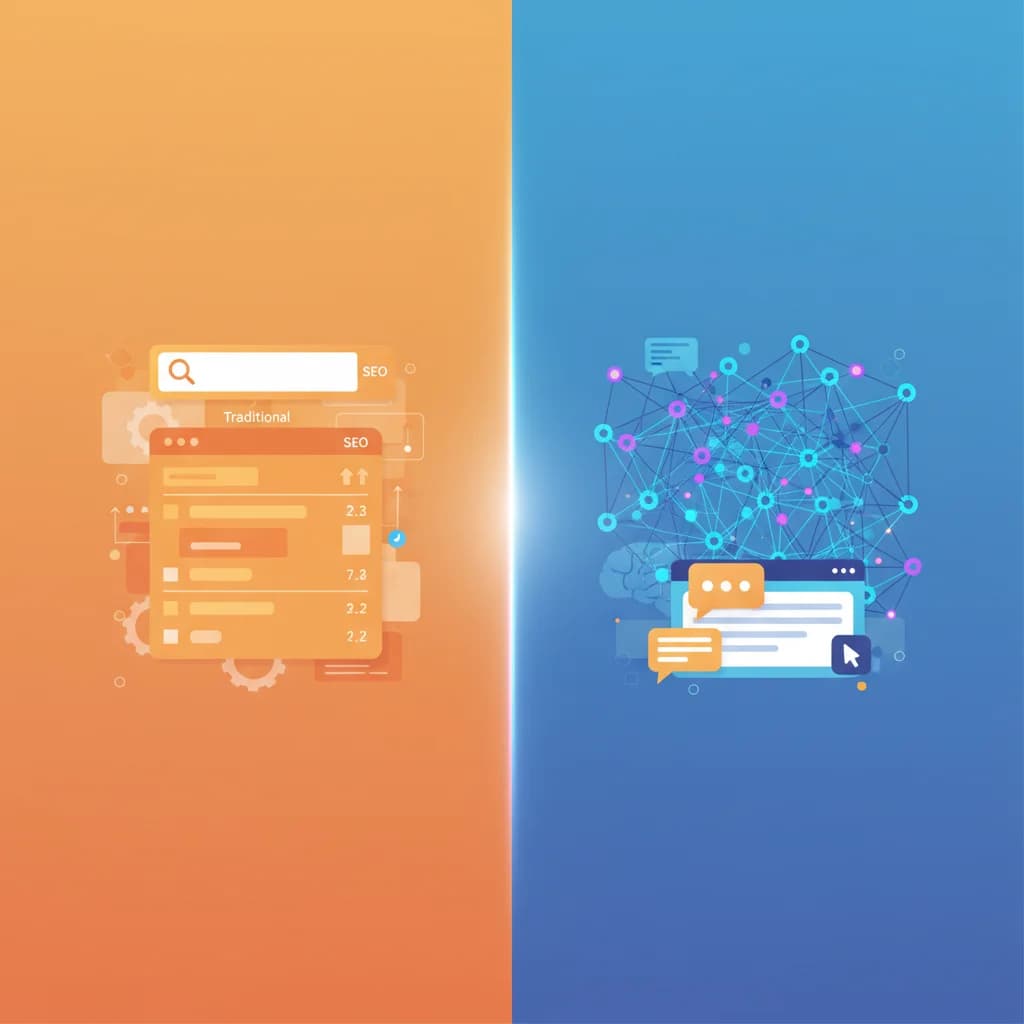
For over two decades, SEO meant one thing: ranking on Google. You researched keywords, built backlinks, optimized title tags, and watched your position on a results page with ten blue links. That era is ending.
In 2026, a growing share of search queries never reach a traditional search engine. Users ask ChatGPT for product recommendations, consult Perplexity for research, and rely on Google's own AI Overviews for instant answers. The question is no longer whether AI search will disrupt SEO. It already has. The real question is what you need to do differently.
This guide breaks down exactly what changes when you optimize for AI search engines versus traditional search, what stays the same, and how to build a strategy that works for both.
AI SEO (also called AEO, or AI Engine Optimization) is not a replacement for traditional SEO. It is an expansion of it. The brands winning in 2026 optimize for both Google's index and the large language models that power ChatGPT, Perplexity, Claude, and Google AI Overviews. The core shift: you are no longer optimizing for a ranking position. You are optimizing to be the answer that an AI cites.
What Is AI SEO (AEO)?
AI Engine Optimization (AEO) is the practice of structuring your content, data, and online presence so that large language models (LLMs) reference, cite, and recommend your brand when answering user queries.
Traditional SEO asks: "How do I rank #1 on Google for this keyword?"
AEO asks: "How do I become the source that AI assistants trust and cite when someone asks a question in my domain?"
The difference is fundamental. In traditional SEO, you compete for positions on a search engine results page (SERP). In AEO, you compete for inclusion in a generated answer, often as the only source mentioned.
AEO covers optimization across multiple AI platforms:
- ChatGPT (OpenAI) -- used by over 200 million people weekly as of early 2025
- Perplexity -- the AI-native search engine processing over 100 million queries per week
- Google AI Overviews -- appearing on roughly 30% of Google searches
- Claude (Anthropic), Microsoft Copilot, Meta AI, and other LLM-powered assistants
- Voice assistants like Siri (now backed by Apple Intelligence) and Alexa
AEO Is Not Just a Buzzword
The term "AI Engine Optimization" emerged because traditional SEO frameworks do not fully account for how LLMs select sources. LLMs do not crawl the web in real time the way Googlebot does. They rely on training data, retrieval-augmented generation (RAG) pipelines, and real-time search APIs. Optimizing for these systems requires different techniques than optimizing for a traditional crawler-based index.
AI SEO vs Traditional SEO: The Full Comparison
The following comparison covers the eight most important dimensions where AI search optimization diverges from traditional SEO.
AI SEO vs Traditional SEO
| Dimension | Traditional SEO | AI SEO (AEO) |
|---|---|---|
| Primary Goal | Rank on page 1 of SERPs | Get cited in AI-generated answers |
| Success Metric | Keyword rankings, organic traffic | Citation rate, brand mentions, share of voice in AI responses |
| Content Format | Long-form pages optimized for keywords | Structured, quotable content blocks with clear factual statements |
| Authority Signals | Backlinks, domain authority, PageRank | Entity reputation, source consistency, author expertise (E-E-A-T) |
| Technical Foundation | Crawlability, site speed, Core Web Vitals | Structured data (Schema.org), knowledge graph presence, machine-readable formatting |
| Keyword Strategy | Exact-match and long-tail keywords | Conversational queries, natural language questions, intent clusters |
| Competitive Landscape | 10 organic results per page | Often 1-3 cited sources per AI answer |
| Update Cycle | Googlebot recrawls pages regularly | LLM training data has a lag; RAG systems update faster but still rely on source trust signals |
| User Interaction | User clicks through to your site | User may never visit your site; your content is synthesized into an answer |
| Local & Commerce | Google Business Profile, map pack | AI recommends specific brands and products by name in conversational answers |
What Stays the Same
Not everything about SEO is changing. Several fundamentals remain just as important in an AI-first search landscape.
1. Content Quality Is Non-Negotiable
Both Google's algorithms and LLMs favor accurate, well-researched, original content. Thin content that exists only to target a keyword performs poorly in both systems. LLMs are particularly good at detecting content that lacks depth, because they process meaning rather than matching strings.
2. E-E-A-T Still Matters (Even More)
Google's Experience, Expertise, Authoritativeness, and Trustworthiness framework directly maps to how LLMs evaluate sources. LLMs trained on web data learn which domains and authors are repeatedly cited by other authoritative sources. If your content already demonstrates strong E-E-A-T signals, you have a head start in AEO.
3. Technical SEO Fundamentals Persist
Fast-loading, well-structured, mobile-friendly pages still matter. AI search tools that use real-time retrieval (like Perplexity and Google AI Overviews) still need to fetch and parse your pages. If your site is slow or poorly structured, these systems will skip it in favor of faster, cleaner sources.
4. User Intent Remains Central
Understanding what users actually want when they type a query is still the foundation of all search optimization. The difference is that AI search makes intent even more explicit, because users ask complete questions rather than typing fragmented keywords.
5. Structured Data Is Still Critical
Schema.org markup, FAQ schema, HowTo schema, and Product schema remain essential. In fact, these structured data formats become even more important in AEO because they provide machine-readable signals that LLMs and RAG pipelines can parse directly.
Quick Win
If you already have strong traditional SEO fundamentals (quality content, solid E-E-A-T, clean technical implementation), you are already 60-70% of the way toward effective AEO. The remaining work is about restructuring how you present information and actively monitoring your AI visibility.
What Changes Completely
Here is where the real paradigm shifts happen.
1. From Rankings to Citations
In traditional SEO, success means appearing on page one. In AEO, success means being the source an AI cites. There is no "page one" in a ChatGPT response. There is either being mentioned or being invisible. This is a binary outcome with much higher stakes.
Research from multiple studies in 2025 found that the top-cited source in an AI answer captures a disproportionate share of brand impressions compared to a #1 ranking on Google, because users perceive the AI's citation as an explicit endorsement rather than just a search result.
2. From Keywords to Entities
Traditional SEO revolves around keywords. AEO revolves around entities: your brand, your products, your people, and the concepts you are associated with. LLMs build internal representations of entities based on how they appear across the web. If your brand is consistently described as an authority on a specific topic across multiple trusted sources, the LLM learns that association.
This means that brand mentions on third-party sites, consistent NAP (Name, Address, Phone) data, Wikipedia presence, and appearances in authoritative publications carry more weight in AEO than exact-match anchor text backlinks.
3. From Traffic to Influence
Traditional SEO is measured by how many people visit your site. AEO introduces a new metric: influence without clicks. When ChatGPT recommends your product to a user, that user may buy directly without ever visiting your website. You gain a customer but lose a pageview.
This forces a fundamental rethinking of marketing attribution. Companies need to track AI mentions and citations alongside traditional traffic metrics.
4. From Pages to Answers
In traditional SEO, you create pages. In AEO, you create answers. This means restructuring your content so that key facts, definitions, statistics, and recommendations are presented in clear, self-contained blocks that an LLM can extract and quote.
Long paragraphs that bury the answer in the middle of a wall of text perform poorly in AEO. Clear headers, concise definitions, and structured lists perform well.
5. From Reactive to Proactive Monitoring
In traditional SEO, you check Google Search Console for ranking changes. In AEO, you need to actively query AI systems to see whether they mention your brand, what they say about you, and whether the information is accurate. This is an entirely new monitoring discipline that did not exist before 2024.
of U.S. adults have used an AI chatbot
Pew Research, 2025
of Google searches show AI Overviews
Search Engine Land analysis
sources cited per AI answer
Average across ChatGPT and Perplexity
weekly ChatGPT users
OpenAI, early 2025
of AI users trust AI recommendations
For product and service decisions
of AI citations come from top 10 domains
Per topic vertical
How to Optimize for Both Google and AI Search
The most effective strategy in 2026 is not choosing between traditional SEO and AEO. It is building a unified approach that covers both.
Structure Content for Dual Consumption
Write content that works for both human readers scanning a webpage and AI systems extracting answers. This means:
- Lead with clear definitions and direct answers in the first paragraph of each section
- Use descriptive H2 and H3 headers that match natural language questions
- Include structured data (FAQ schema, HowTo schema, Article schema) on every piece of content
- Create quotable statements -- concise, factual sentences that an AI can extract and cite with attribution
Build Entity Authority
Go beyond backlinks. Build a consistent, authoritative presence for your brand entity across the web:
- Claim and optimize your knowledge graph presence (Wikipedia, Wikidata, Crunchbase, LinkedIn)
- Ensure brand consistency across every platform where your brand appears
- Publish original research and data that other sources want to cite
- Get mentioned (not just linked) by authoritative publications in your industry
Monitor AI Visibility
You cannot optimize what you do not measure. Start tracking:
- How often AI assistants mention your brand when answering relevant queries
- What specific claims AI systems make about your products or services
- Which competitors are being cited in AI answers for your target topics
- Whether AI-generated information about your brand is accurate and up to date
The Attribution Gap
One of the biggest challenges in AEO is the attribution gap. When an AI recommends your product without the user clicking through to your site, traditional analytics tools see nothing. You need dedicated AI monitoring tools (like CiteKit) to close this gap and understand your true share of voice in AI-generated responses.
Invest in Structured Data and Technical AEO
Go beyond basic SEO technical requirements:
- Implement comprehensive Schema.org markup (Organization, Product, FAQ, HowTo, Article, and Author schemas)
- Create a machine-readable knowledge base with clear entity relationships
- Ensure your robots.txt and AI-specific crawl directives allow AI systems to access your content (be strategic about what you expose)
- Use consistent, canonical URLs so AI systems can reliably attribute content to your domain
Step-by-Step: Transitioning from SEO-Only to SEO + AEO
How to Add AEO to Your Existing SEO Strategy
Audit Your Current AI Visibility
Start by querying the major AI platforms with the same questions your customers ask. Record whether your brand is mentioned, cited, or recommended. Note which competitors appear instead. This baseline audit reveals your starting position and identifies the biggest gaps.
Use queries like:
- "What is the best [your category] tool?"
- "Compare [your brand] vs [competitor]"
- "[Your industry] recommendations for [use case]"
Restructure Your Highest-Value Content
Take your top 10-20 pages by traffic or revenue impact and restructure them for AI consumption. Add clear definitions in the opening paragraphs. Break complex information into structured lists and tables. Create self-contained answer blocks that can stand alone as citations.
Focus on making every H2 section answer a specific question completely within its first two paragraphs.
Implement Comprehensive Structured Data
Structured data is the bridge between your content and AI systems. Implement:
- Organization schema with your brand details
- FAQ schema on pages with question-answer content
- HowTo schema on tutorial and guide pages
- Product schema on product and pricing pages
- Author schema with linked author profiles that demonstrate expertise
Build Entity Authority Across the Web
LLMs build entity understanding from the broader web, not just your site. Ensure your brand has consistent, accurate information on Wikipedia (if notable), Wikidata, Crunchbase, industry directories, and authoritative review sites. Publish original research that gets cited by other publications.
Set Up Ongoing AI Monitoring
AEO is not a one-time optimization. AI models update their knowledge, competitors improve their content, and user queries evolve. Set up continuous monitoring to track your citation rate, detect inaccuracies in AI responses about your brand, and identify new opportunities where competitors are being cited but you are not.
Create an AEO Content Calendar
Based on your monitoring data, identify the queries where you want to be cited but currently are not. Create content specifically designed for these gaps: original research, definitive guides, clear product comparisons, and expert commentary that AI systems will want to reference.
Prioritize topics where:
- Users frequently ask AI assistants for recommendations
- Current AI answers lack good sources or contain outdated information
- Your brand has genuine expertise and authority
The biggest shift in search since Google launched is not a new search engine. It is the move from searching for links to asking for answers. Brands that understand this shift will dominate the next decade.
Rand Fishkin
Co-founder, SparkToro
The Business Case for AEO in 2026
The economic argument for investing in AEO alongside traditional SEO is straightforward. AI-assisted search is growing exponentially, and the brands that establish authority now will have a durable competitive advantage as AI search volume continues to increase.
Consider these trends:
- AI search query volume is doubling year over year. ChatGPT, Perplexity, and other AI assistants are processing billions of queries monthly, and that number is accelerating.
- AI Overviews are reducing traditional click-through rates. When Google shows an AI Overview, organic CTR for the queries affected drops significantly because users get their answer without clicking.
- AI recommendations drive high-intent conversions. Users who receive a specific product recommendation from an AI assistant are more likely to convert than users who click through a generic search result, because the AI has already done the comparison and filtering work.
- Early movers in AEO capture disproportionate share of voice. LLMs develop source preferences based on training data. Brands that are well-represented in current training data will continue to be favored in future model versions, creating a compounding advantage.
YoY growth in AI search queries
CTR decline on queries with AI Overviews
higher conversion rate from AI recommendations
Common Mistakes When Transitioning to AEO
Avoid these pitfalls as you expand your SEO strategy to include AI optimization:
Abandoning traditional SEO entirely. Google still drives the majority of search traffic. AEO is an addition to your strategy, not a replacement. The content that ranks well on Google is often the same content that AI systems cite.
Trying to manipulate AI responses directly. Some brands attempt to inject specific language into content hoping LLMs will parrot it back verbatim. This is short-sighted. LLMs synthesize information from multiple sources and are increasingly good at detecting promotional language. Focus on being genuinely authoritative.
Ignoring accuracy and freshness. LLMs amplify inaccuracies. If your content contains outdated statistics or incorrect claims, an AI might cite them to millions of users, creating a brand reputation problem at scale.
Not monitoring AI responses about your brand. Without monitoring, you will not know what AI systems say about you until a customer or journalist tells you. Proactive monitoring is essential.
Focusing only on your own site. In AEO, your off-site presence matters as much as your on-site content. Third-party mentions, reviews, and citations all influence how LLMs perceive your brand entity.
Frequently Asked Questions
Start Tracking Your AI Visibility Today
The shift from traditional search to AI-powered search is not a future prediction. It is happening now. Every day that you are not monitoring and optimizing your presence in AI responses is a day your competitors can get ahead.
The brands that will lead in 2026 and beyond are those building a dual strategy today: maintaining their Google rankings while actively optimizing for AI citations.
See How AI Search Engines Talk About Your Brand
CiteKit monitors your brand's visibility across ChatGPT, Perplexity, and Google AI Overviews. Get your free AI visibility audit and see exactly where you stand.
Start Free AI Visibility Audit